
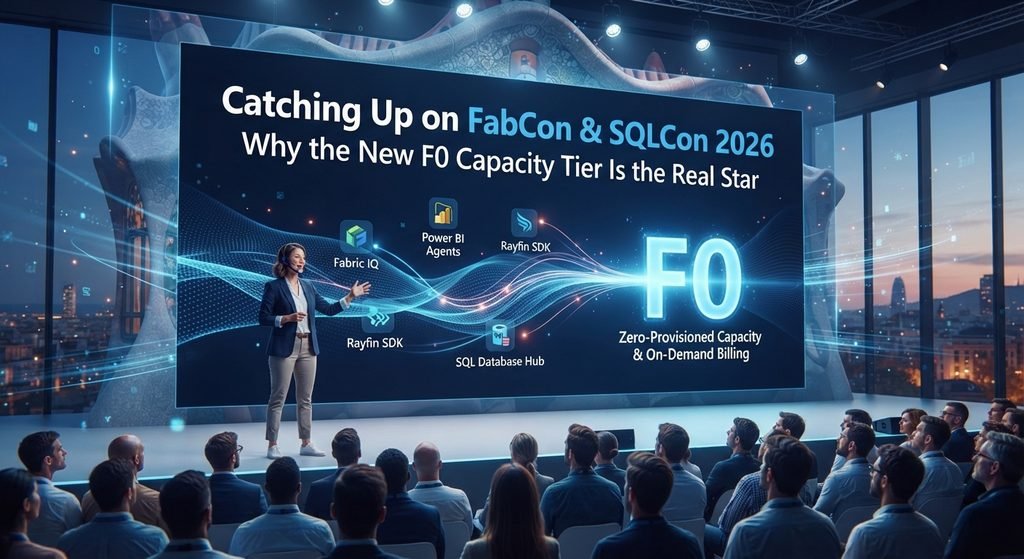
While I wasn’t able to catch the action live in Barcelona last week for FabCon and SQLCon 2026, keeping tabs on the announcements has been a wild ride. Microsoft Fabric has officially cleared the 40,000-customer milestone and the event heavily emphasized Frontier Transformation – moving past standard AI productivity hacks and embedding autonomous agents directly into corporate workflows.
Yet, among all the flashy Copilot integrations and agentic apps, one specific announcement completely stole the show for me: the introduction of the F0 capacity tier with on-demand billing.
For anyone who has ever wrestled with budget approvals just to test out a new data platform, this is a game-changer. Let’s dive into why F0 is my favorite takeaway, alongside a full roundup of everything else that dropped in Barcelona.
1. My #1 Favorite: The F0 Capacity SKU & Pay-As-You-Go Billing
Historically, dipping your toes into Microsoft Fabric meant committing upfront to a reserved compute tier (like an F2 or higher). If you just wanted to spin up a quick test environment, build a proof of concept, or play with OneLake shortcuts, you still had to navigate a monthly capacity bill.
- What’s new: Microsoft introduced F0, a zero-provisioned capacity SKU featuring true on-demand billing.
- Why it’s a massive deal: It acts as the “serverless” equivalent for Fabric. You can now evaluate features, run lightweight development tasks and test out workloads without locking into an upfront monthly reservation. Compute costs finally align strictly to what actually runs, shattering the barrier to entry for smaller teams and developer sandboxes.
2. Grounding Microsoft Copilot with Fabric IQ
AI tools often hallucinate because they lack proper context. Microsoft is tackling this by wiring business context directly into Microsoft Copilot.
- What’s new: Fabric IQ is generally available as a shared intelligence bridge, connecting OneLake data, Power BI semantic models and operational metrics directly into Copilot Chat and Cowork – with zero additional AI token costs.
- Why it matters: Instead of guessing, your organization’s Copilot can answer business questions using the exact semantic data definitions your teams already trust and govern.
- Read more: Check out Arun Ulag’s keynote overview on the official Microsoft Azure Blog.
3. Power BI’s Evolution: Agentic App Creation
Power BI is stepping past standard dashboards into operational application building.
- What’s new: You can use natural language inside Power BI Desktop to build, preview and publish purpose-built data applications straight from a trusted semantic model. These apps can handle inputs, write-back data and power workflows.
- Why it matters: Power BI Pro and Premium Per User (PPU) users will get access to Fabric Apps and Fabric Database capabilities (up to 1 GB per app) at no additional cost.
- Read more: Dive into Mohammad Ali’s deep dive on Power BI’s next chapter: The evolution of business intelligence.
4. Fast-Tracking Apps to Production with Fabric Apps & Rayfin
Prototyping an app with AI is easy, but getting it to a secure production environment used to mean heavy lifting. Fabric Apps solves this.
- What’s new: Using the open-source Rayfin SDK and CLI, developers can build app backends and deploy them directly to Fabric with built-in TypeScript functions, a Secret Store, PostgreSQL support and private-by-default security.
- Why it matters: Apps plug straight into existing Lakehouses and Warehouses without data duplication.
- Read more: Catch Sachin Patney’s post, From prompt to production: What’s new in Fabric Apps.
5. Expanding the OneLake Ecosystem & IQ Sharing
- What’s new: Microsoft rolled out IQ sharing (in preview), allowing organizations to securely share governed data, markdown agent instructions and ontologies across different teams, partners and external ecosystems.
- Read more: Read Dipti Borkar’s breakdown on What’s new in Microsoft OneLake and its rapidly growing ecosystem.
6. Autonomous Data Engineering Agents
- What’s new: Driven by technology from the Osmos acquisition, Microsoft introduced a preview of the Fabric data engineering agent. Rather than just auto-completing code snippets, this agent handles complex, long-running engineering tasks like migrations, ETL pipeline creation and modernizations based on human guardrails.
- Read more: Check out Bogdan Crivat’s blog on Bringing governed analytics into the flow of work: Fabric Analytics at FabCon Europe 2026.
7. SQLCon: Scale, Intelligence, and Serverless Pauses
Running parallel to FabCon, SQLCon delivered major updates for database administrators balancing traditional relational databases with modern demands.
- What’s new: A new Database Hub (Public Preview) serves as a single pane of glass to monitor health and security across SQL Server, Azure SQL and PostgreSQL. Plus, DiskANN vector indexes are now generally available to supercharge native semantic search using T-SQL.
- Read more: Read Shireesh Thota’s update on SQLCon Barcelona 2026: Advancing SQL with greater control, scale and intelligence.
Final Thoughts: Looking Ahead
Reflecting on everything announced in Barcelona, it’s clear that Microsoft is moving faster than ever to bridge the gap between heavy-duty data engineering and practical, AI-driven applications. While agentic workflows and Copilot enhancements grab the headlines, structural updates like the F0 tier are what truly make this ecosystem accessible to everyone from lone developers to enterprise architects.
Honestly, I am still trying to digest all these announcements made and also can’t wait to try them soon! We are officially stepping into an era where building, scaling and operationalizing data isn’t just about managing tables – it’s about powering the intelligence layer that runs the business.
Are you as thrilled about the F0 capacity tier as I am? What feature from FabCon are you testing first? Let me know in the comments below!